My Experience Using ChatGPT Advanced Voice to Brainstorm While Driving
My first real voice chat with AI. And yes, it happened behind the wheel.

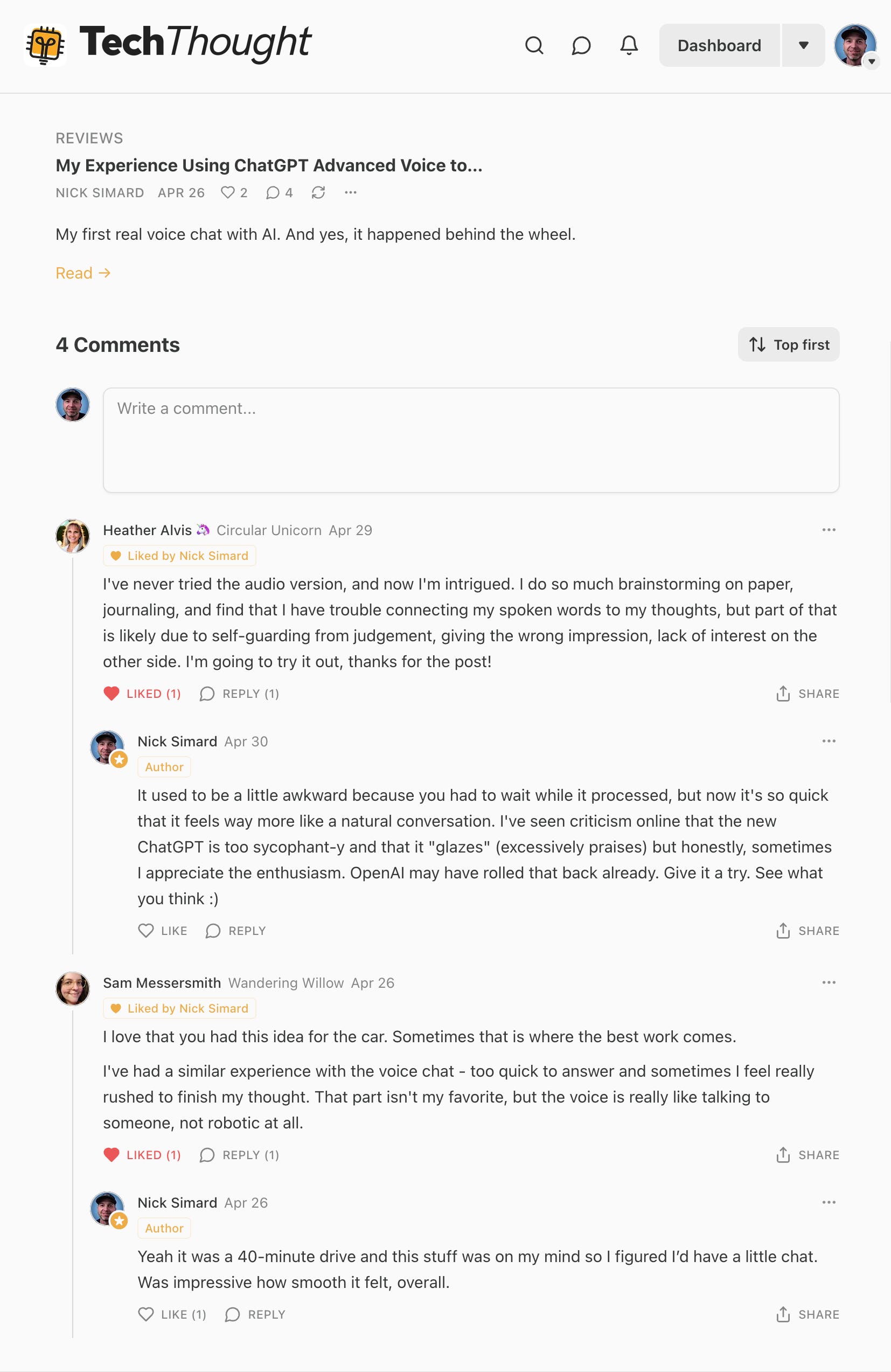
This post was originally published on April 26, 2024 in another Substack publication of mine, TechThought. I've added a screenshot of the comments at the bottom of this post, for archival purposes :)I don't know what it is about driving, but that's when my brain loves to throw out ideas. Big ones, messy ones, half-finished ones. And most of the time, they vanish before I can do anything about them.
So when I heard that ChatGPT's advanced voice mode could hold a real conversation — not just take dictation — I figured it was worth a test drive. (Literally.)
NOTE: The chat described below happened on April 14th, and I’d had limited experience with any previous voice chat versions. Setup & How It Works
If you haven't tried it yet, OpenAI's advanced voice chat feature is surprisingly polished—and a little bit weird in the best way.
It's currently available in the mobile app for both iOS and Android. You'll need to tap the audio waveform icon in the bottom right corner.
ChatGPT's free plan includes a limited preview of its Advanced Voice Mode, powered by GPT-4o mini, which allows users to have voice conversations with the AI. However, free users have a daily limit on their voice interaction time. For unlimited and more advanced voice conversations, users need to subscribe to ChatGPT Plus
To get started, you choose from a handful of preset voices. I went with Sky, which has this friendly, slightly animated tone—somewhere between a podcast host and a calm flight attendant. Once you start the chat, you just speak. No need to hit "stop" or manually submit. GPT listens, processes, and responds with natural pauses and tone shifts that feel like real conversation.
And it's fast. Like, almost unnervingly fast.
In my case, I had the phone mounted in my car, running the app through my car's Bluetooth. I'd ask a question or drop a half-formed thought, and GPT would respond before I even finished the sentence in my head. No lag. No weird repetition. No robotic mispronunciations.
Just a smooth, rolling conversation with a machine that never asks if we're there yet.
Conversation Flow
What surprised me most wasn't just how natural GPT sounded. It was how fluid the conversation felt. There were no "Hey Siri?" wake words, no clunky re-prompts. I'd say something like:
"I've got two newsletters. One is more tool-focused, the other is more reflective. Any ideas for how to cross-pollinate content between them?"
And GPT would respond not only with helpful suggestions, but with follow-up questions, like:
"What kind of overlap do you see between your audiences? Are the tones similar enough for shared content, or would you want to adapt each post to fit?"
That kind of back-and-forth made it feel less like a glorified voice memo and more like a live ideation session with someone who's not just listening, but actively thinking alongside you.
It didn't always nail the nuance. Once or twice, it offered ideas I'd already considered or took the conversation in a slightly generic direction. But to be fair, I've had worse conversations with humans after 10pm.
The most impressive part? It kept up with topic shifts. I'd pivot mid-thought—from newsletters to Substack Notes to how I could turn an Airtable tutorial into a product—and GPT followed along without missing a beat. I didn't feel the need to "talk like a prompt."
I just talked.
Surprises & Quirks
There were a few moments during the drive where I genuinely forgot I was talking to an AI.
That's partly because the voice is that natural, but also because it handled pauses, interruptions, and even vague thoughts better than expected.
I'd say something like "Okay, wait—what if instead of two posts, I did like...a shared series or something?" and GPT wouldn't stumble. It would pick up on the uncertainty, unpack the idea, and offer a few variations, like:
"You could launch a recurring column that appears in both newsletters, framed slightly differently depending on the tone. Want me to help brainstorm titles?"
Yes. Yes, I do.
There were quirks, of course. Occasionally, it responded before I'd finished my sentence, which made it feel a little too eager. And once, when I paused to merge lanes, it tried to "move the conversation forward" a little prematurely, interpreting silence as a cue to shift topics.
Minor hiccups, but they reminded me that while it feels conversational, it's still a system running predictions--not a mind reading mine.
Also worth noting: if your car isn't dead quiet or your Bluetooth is spotty, there's a chance it might miss a word or two. Mine handled highway noise just fine, but I can imagine a louder setting might introduce some friction.
Still, the smoothness of the experience overall was uncanny. If this is V1 of AI voice interaction at scale... buckle up. No pun intended.
Was It Actually Helpful?
Short answer: yeah. Surprisingly so.
This wasn't just a novelty experience. I left the car with a legit list of usable ideas, a clearer sense of direction for both of my newsletters, and the kind of excitement that usually only comes from talking shop with a smart friend who actually gets it.
What made it helpful wasn't just the content of GPT's responses (though those were solid). It was the real-time back-and-forth. Talking out loud helped clarify my own thinking, and GPT's follow-ups nudged me toward sharper ideas without steering too hard. It didn't try to solve everything, but it helped me think through everything.
And here's the kicker: because it was voice-based, the friction to start thinking out loud was almost zero. I didn't have to type, didn't have to open a doc, didn't even have to remember everything perfectly—just talk, react, build. That's a big deal for people like me who often do their best thinking in motion.
It didn't replace deeper work or focused writing, but it absolutely earned a spot in my toolbox for those moments when I'm on the go and my brain's firing.
Final Thoughts: Would I Do It Again?
Absolutely. In fact, I kind of can't wait.
Update: since first writing this posts I have used it again to flesh out some ideas. This time, while walking back from a haircut.
Not every moment in the car is meant for conversation, especially with an AI. But for the right kind of drive—quiet, solo, late-night or early-morning when your brain is doing that hazy, idea-hungry wander? GPT makes a surprisingly good companion.
It's not quite human, and it doesn't pretend to be. But it listens without interrupting, responds without judgment, and somehow manages to pull useful threads out of half-baked thoughts. That's more than I can say for some many meetings I've been in.
Is it perfect? No. It still has its tells—it's a little too polite, a little too quick to please—but it's good enough that I've now got a new ritual: drive, talk, think, build.
So next time you find yourself behind the wheel with a head full of ideas and no one to bounce them off... maybe don't scramble for a voice note or try texting yourself while driving. Just tap the little audio waveform icon and let your AI co-pilot ride shotgun.

Have you tried the latest advanced voice on ChatGPT? Love it? Hate it? Lemme know in the comments!
Comments from the original post